

In the first two posts of this series, I covered a lot of ground about what makes software defensible in an AI-saturated world. Post 1 was about the distinction between deterministic and probabilistic systems — the argument that for many of the most important business workflows, “usually right” is not actually a viable operating standard, and that encoded software retains durable value precisely because it behaves predictably every single time. Post 2 was about speed and efficiency — the idea that just because a Large Language Model (LLM) can handle a workflow doesn’t mean it should, especially when that workflow runs at high velocity and/or needs to be fast and inexpensively executed.
Both of those arguments, ultimately, are about why encoded software still matters. This post is a bit more about how AI and encoded software can work together.
UX is Changing
There has been a lot of talk about “headless” platforms that are operated primarily through LLM GPTs and/or via agents. While I personally do not believe that traditional graphical user interfaces (GUIs) are going away entirely (I think they’ll still have their place), I do think that user experience (UX) channels will change significantly over the next few years. That GUI is going to share the stage with LLMs acting as the user interface, and agents will increasingly operate the software — AI systems acting on behalf of users, instead of users clicking around a screen, to complete specific tasks as part of a larger workflow.
That is a fundamentally different operating model, and it has real implications for how you think about product design and, frankly, how you think about your company’s value proposition. But I think most software platforms should lean into it.
What a Tool Actually Means
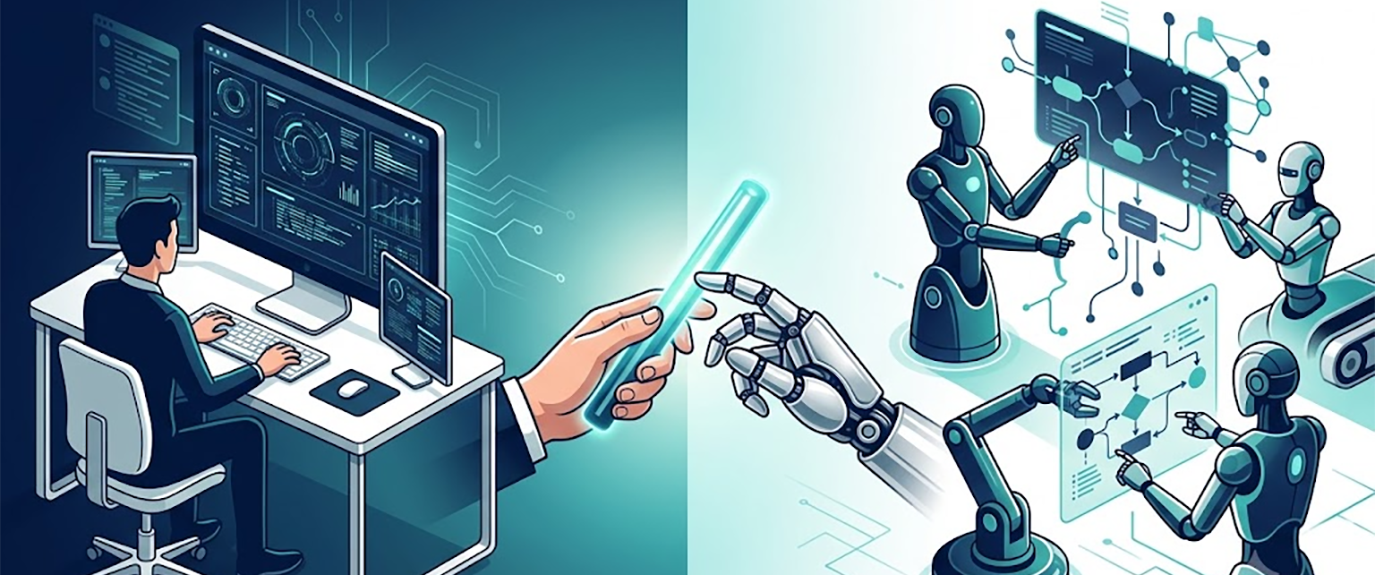
When you ask an LLM to do something like schedule a meeting, that’s not all happening inside the model’s core reasoning layer. The LLM interprets the intent, and then it reaches out to purpose-built software to actually execute. That purpose-built software is called a tool. The AI passes the baton and then waits for something to come back.
So while the LLM serves as the core translation and reasoning engine — turning your English-language prompt into tokens and ultimately 1s and 0s — in an agentic workflow, a lot of the important work doesn’t actually happen in the “AI.” It happens in the software that the AI relies on to get things done.
Which brings me to the title of this post. Go on, be a tool. Because if you build software that does something genuinely valuable — something faster, more accurately, or with more domain-specific insight than anyone else — and you make it callable by agents, you have just extended your platform’s relevance into a world that a lot of people are assuming will route around you.
The Core Value Prop Isn’t Changing, but the Interaction Patterns Will
The fundamental business question for any software company has always been some version of: what do you do better than anyone else? What can you deliver — an output, an analysis, a result — that a customer couldn’t get elsewhere, which delivers real business value? That question doesn’t change in an agentic world. What changes is who, or what, is asking it.
The portfolio companies we work with are, in many cases, sitting on genuinely differentiated capabilities. Years of proprietary data. Domain-specific logic that took a long time to build and would take even longer to replicate. Workflow expertise embedded into product in ways that aren’t visible from the outside. That’s valuable for a human user today. It’s equally valuable — in many cases more so — for an agent operating on behalf of that user tomorrow. The agent still needs someone to pick up the baton. The question is whether your software is positioned to do that.
The Baton Pass
So here’s the practical challenge. If an agent is orchestrating a complex workflow — pulling context from multiple sources, making decisions, acting on behalf of an end user who is waiting somewhere for a result — and it identifies that a specific piece of your platform is the right tool for a particular step, can you actually receive that handoff? Are you open to that handoff? Can you pick up the baton and deliver something back that is worth having waited for — and are you open to that paradigm?
That’s not a purely technical question, though it has technical dimensions. It’s a product strategy and product management question. It’s a question about how you think about your platform’s perimeter — not just what it does for a human sitting in front of a screen, but what it can do as a node in a larger automated system, and how you think about different “users” leveraging the software. In the future you may have to cover multiple “user” experiences and workflows.
I believe the companies that figure this out early — that invest in making their differentiated capabilities agent-accessible, not just human-accessible, and structure their platform in an appropriate way to drive real business value — are going to have a significant advantage.
Defensibility in the age of AI may be as much about how you deliver your distinctive value proposition alongside AI, as it is about that distinctive value proposition itself!